 NEUON AI SDN BHD
NEUSLM — small language models
NEUON AI SDN BHD
NEUSLM — small language models
NEUSLM
Three use cases, one engine
- 01 Context Mining
- 02 OCR + SLM
- 03 Self-hosted SLM
The slide
Three things a small model does with a document.
NEUSLM is the engine under the rest of the constellation: small, domain-tuned models that read what an institution already holds and write it into records the institution can query. This slide deck contain — three pictures of that engine at work, on documents that came off a counter, out of a herbarium and off a laptop in the office.
None of the three is a demonstration built for a slide. They are a supermarket receipt with its card slip, a Sarawak herbarium voucher, and a locally hosted model answering a question about the company that hosts it.
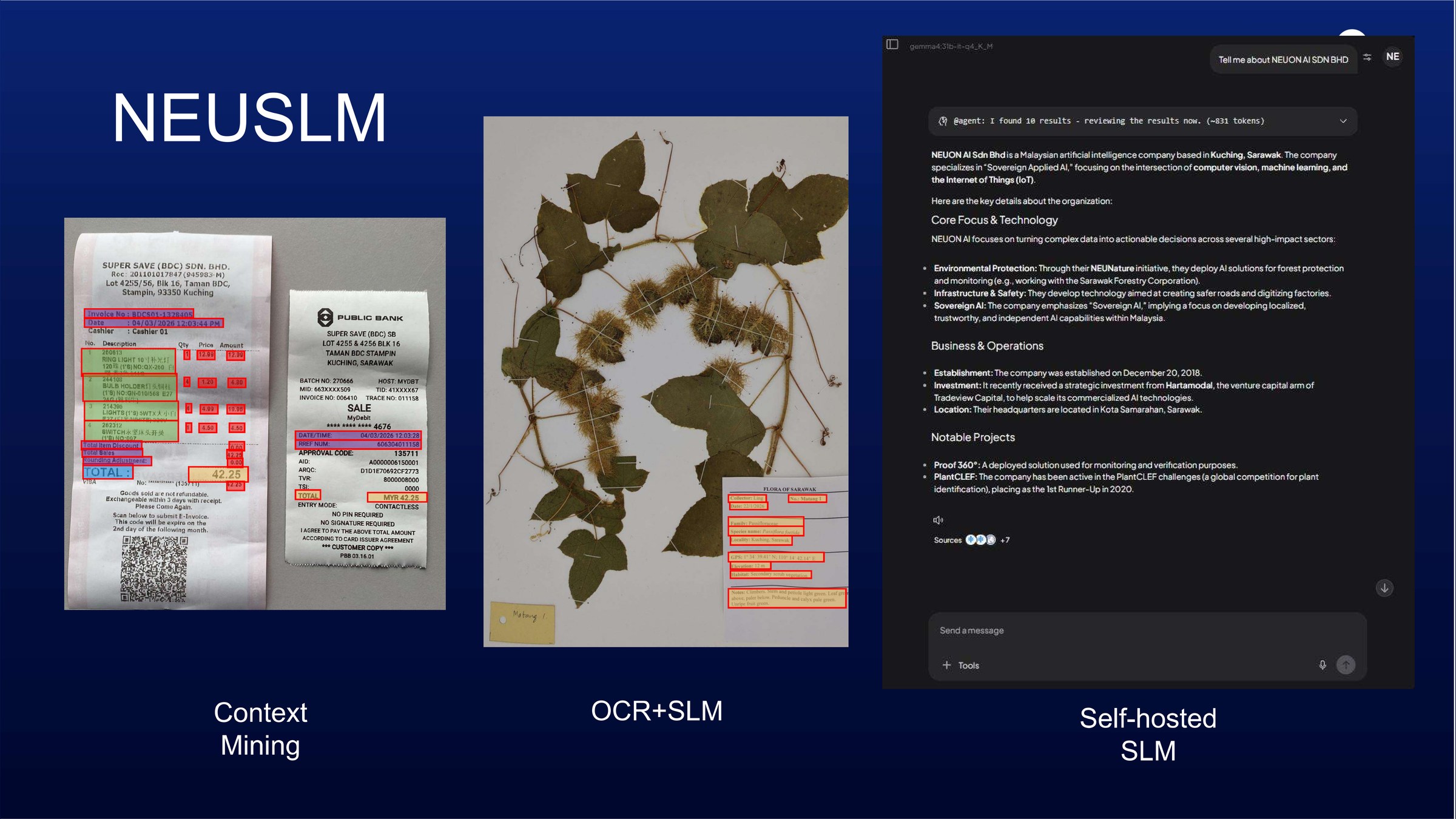
The use cases
Three documents. Three different jobs.
Each one answers a different question, and they build: read a document, read a record, then ask the whole pile something. Press a card to read it.
Reconcile
Context Mining — reconcile
Two documents, one purchase, and a number that has to match.
A photograph of each document → field extraction on all of them → one cross-checked record.→ A reconciled record
In words
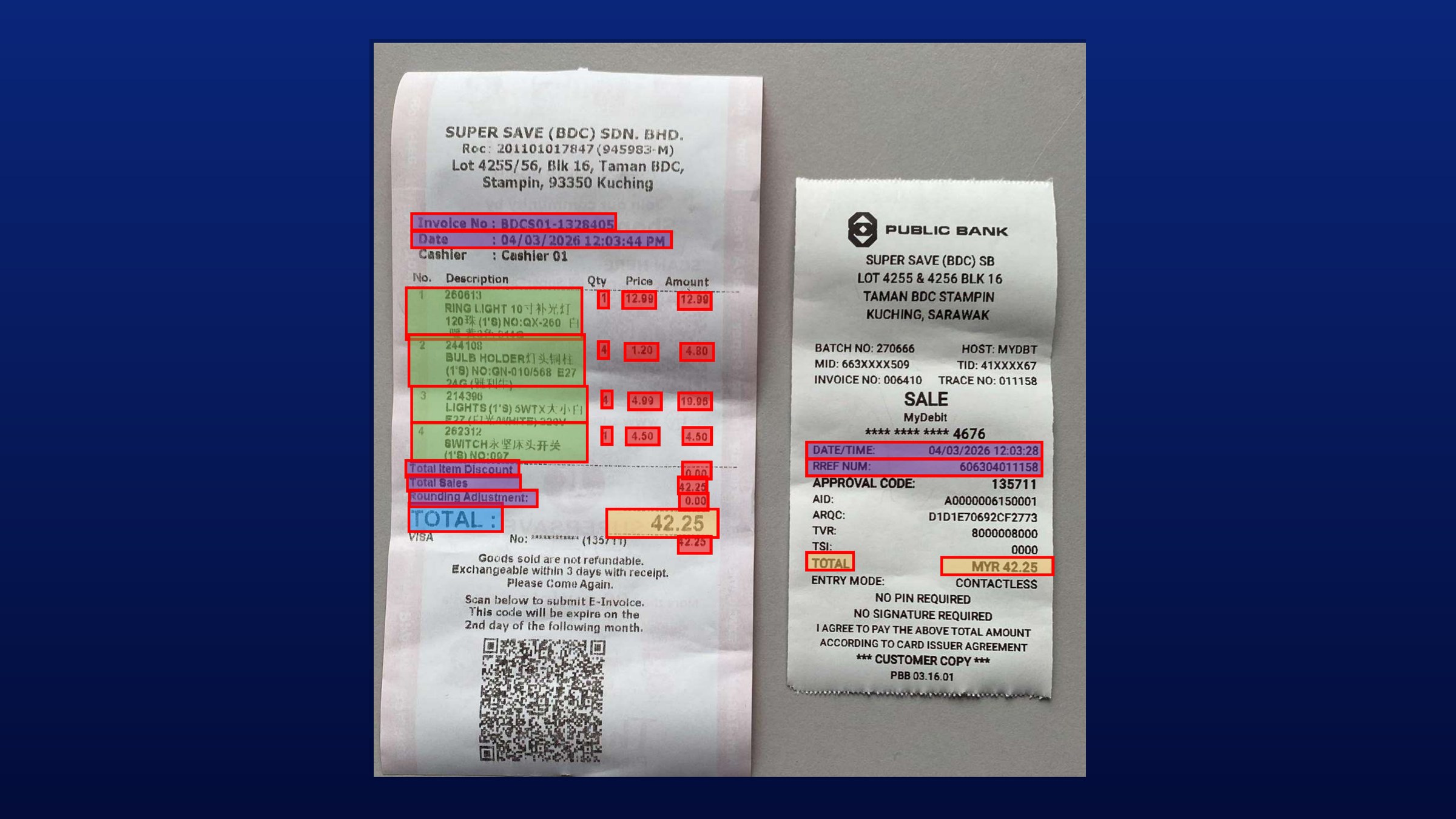
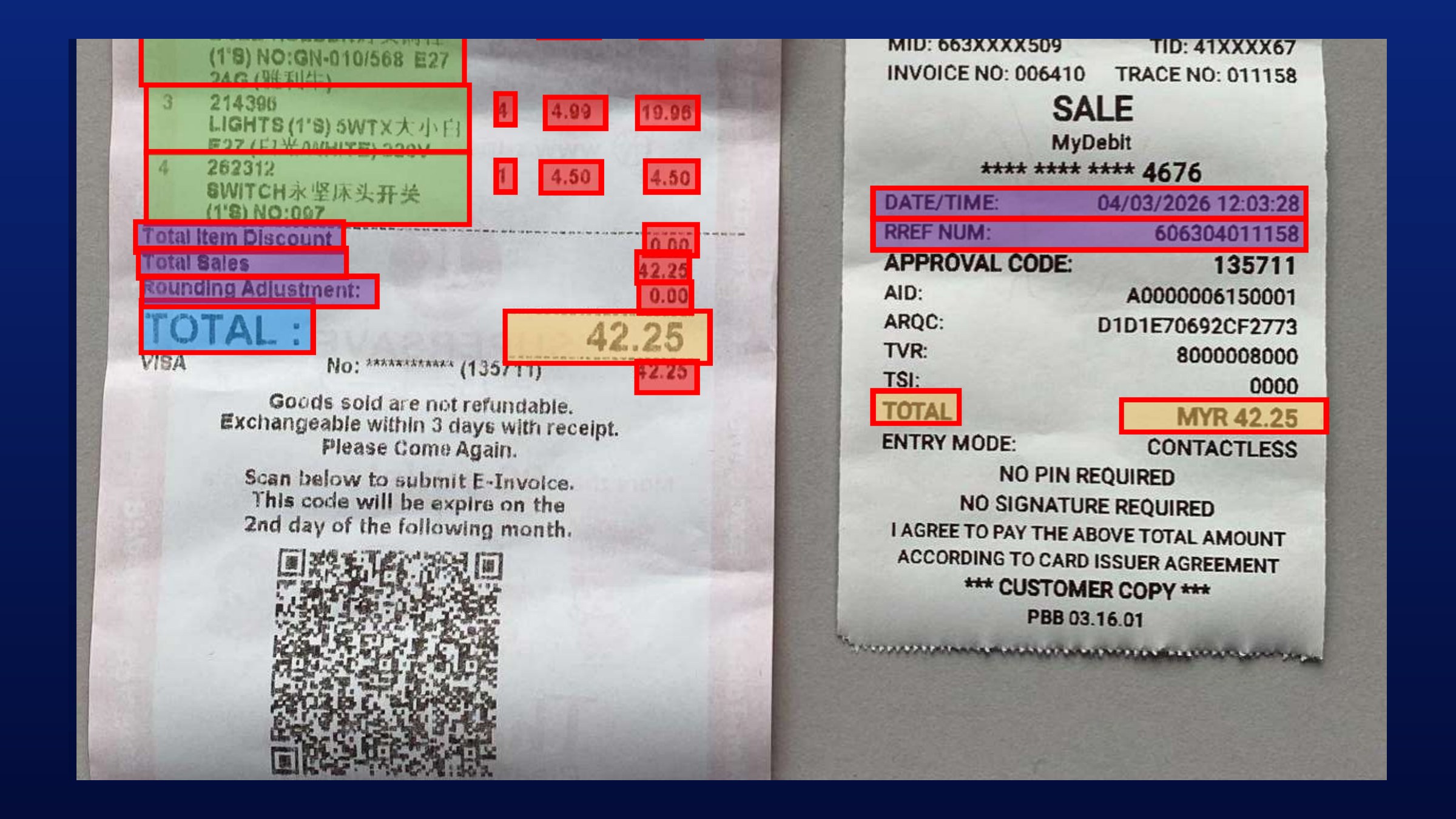
The first picture is a supermarket receipt and the card-terminal slip for the same purchase, photographed together on one desk. Every field worth keeping is marked on both. On the receipt: the invoice number, the date and time, and each line of the sale — item code, description, quantity, unit price, amount — then the item discount, the total sales, the rounding adjustment and the total. On the slip: the date and time, the retrieval reference number, the approval code, the entry mode and the amount.
The argument is in the last line of each. 42.25 on the receipt. MYR 42.25 on the slip. The timestamps are sixteen seconds apart. Reading either document on its own gives you a number; reading both gives you a number that has been checked against the other piece of paper in the same envelope — which is exactly what a finance officer does by hand, one claim at a time, all week.
The line items are mixed script — RING LIGHT 10寸补光灯, SWITCH永坚床头开关 — because that is what is printed on receipts here. A model tuned on the documents that actually cross a Malaysian counter reads those. One tuned on the internet's idea of a receipt does not, and the failure is quiet: it returns a plausible line with the wrong description on it.
- What comes out is a record, not a transcript. Invoice number, date, merchant, each line with its quantity and unit price, discount, rounding, total — columns, in a table, that somebody can query a year later.
- The cross-check is the product. Two documents that disagree are the thing worth surfacing; two that agree are a claim that can be approved without anybody reading it.
- The QR code on the receipt is the e-Invoice submission code — the receipt says so itself: "Scan below to submit E-Invoice. This code will be expire on the 2nd day of the following month." Paper and tax record are already two views of one transaction. This makes the third view queryable.
- On this site it is already named Autodoc AI — "receipts, reports, permits and correspondence read once and turned into queryable records, so an institution can finally ask its own archive a question."
Read
OCR + SLM — read the record
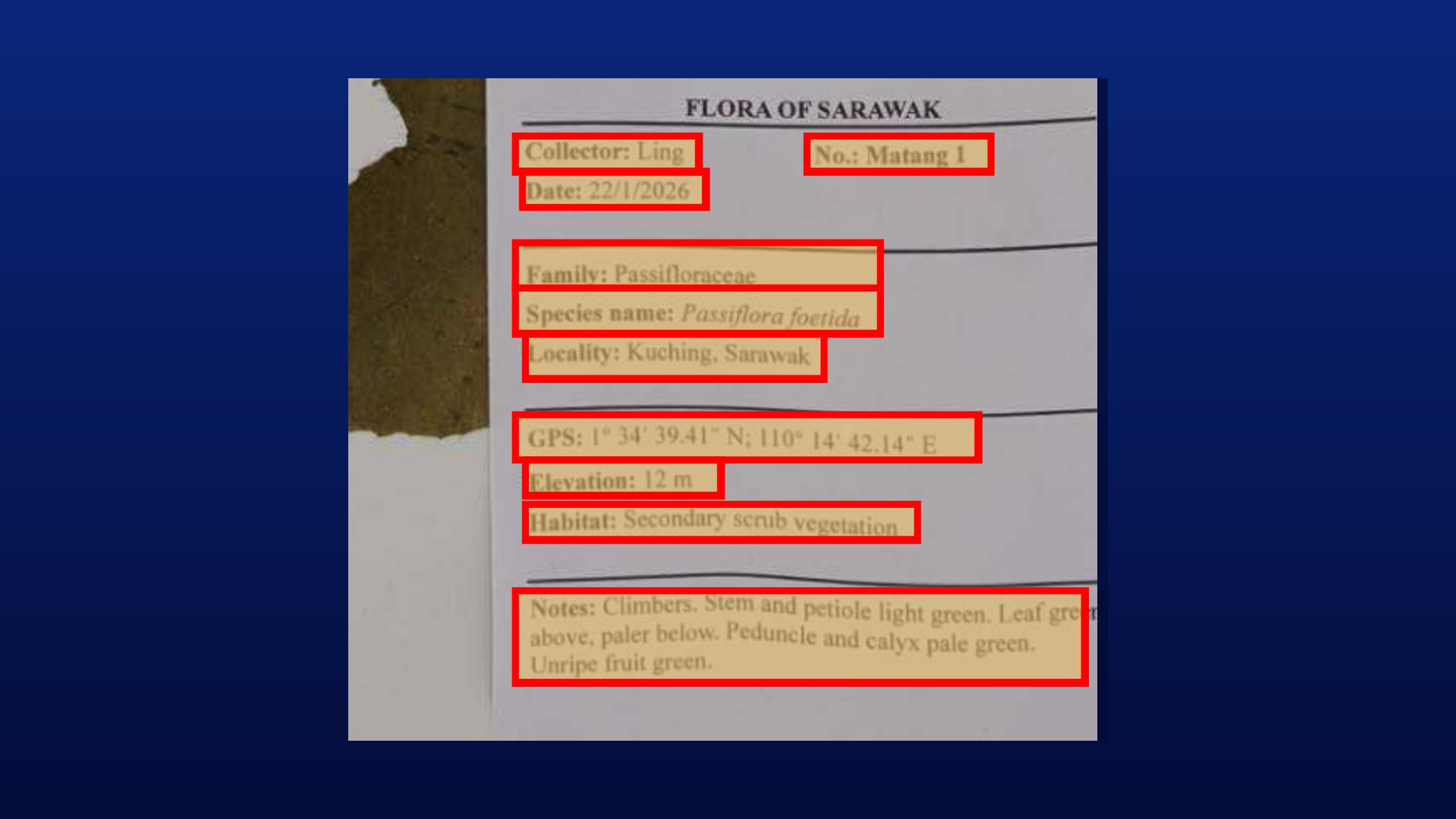
A Sarawak herbarium voucher, read field by field into typed values.
Photograph of the sheet → text detection → field-by-field extraction → typed values.→ A database record
In words
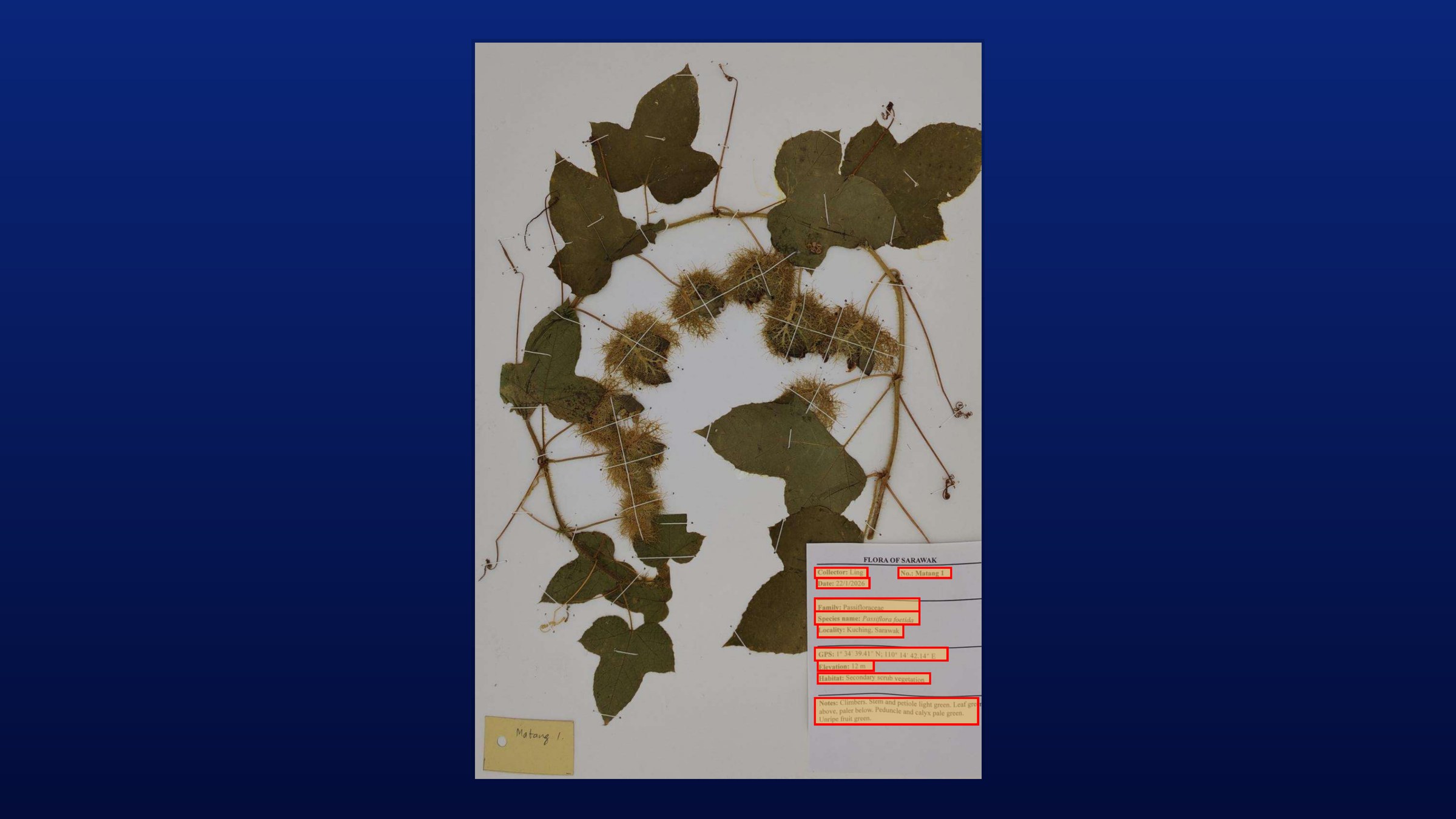
The second picture is a pressed Passiflora foetida on a herbarium sheet, with its FLORA OF SARAWAK voucher label at the foot and ten fields boxed on it: collector, collection number, date, family, species name, locality, GPS, elevation, habitat, and the collector's own field notes.
Why the slide's own caption is OCR + SLM and not OCR: an optical reader hands you the characters. What is wanted is family = Passifloraceae, species = Passiflora foetida, elevation_m = 12, gps = 1°34'39.41"N 110°14'42.14"E — the label's layout, its abbreviations and its handwriting understood as a botanist's record rather than as a page of text. Recognising the characters is the easy half; knowing that "No.: Matang 1" is a collection number and not a street address is the other one.
Sarawak's herbaria hold a great many of these sheets. So does every land office, every registry and every records room in the state: a form designed decades ago, filled in by hand, filed, and never queryable again. Same shape of problem, same shape of answer — and the reason this sits beside NEUNature, which has been entering the PlantCLEF plant-identification challenge since 2020.
- The ten fields on this one sheet. Collector: Ling · No.: Matang 1 · Date: 22/1/2026 · Family: Passifloraceae · Species name: Passiflora foetida · Locality: Kuching, Sarawak · GPS: 1° 34' 39.41" N; 110° 14' 42.14" E · Elevation: 12 m · Habitat: Secondary scrub vegetation · Notes: "Climbers. Stem and petiole light green. Leaf green above, paler below. Peduncle and calyx pale green. Unripe fruit green."
- The notes field is the one that needs a language model. It is free prose written by a person in the field, and it still has to come out as something a database can hold.
- On this site it is already named FormReader — handwritten and printed forms captured at the counter, in Bahasa Malaysia and English, without re-keying.
Ask
Self-hosted SLM — ask it
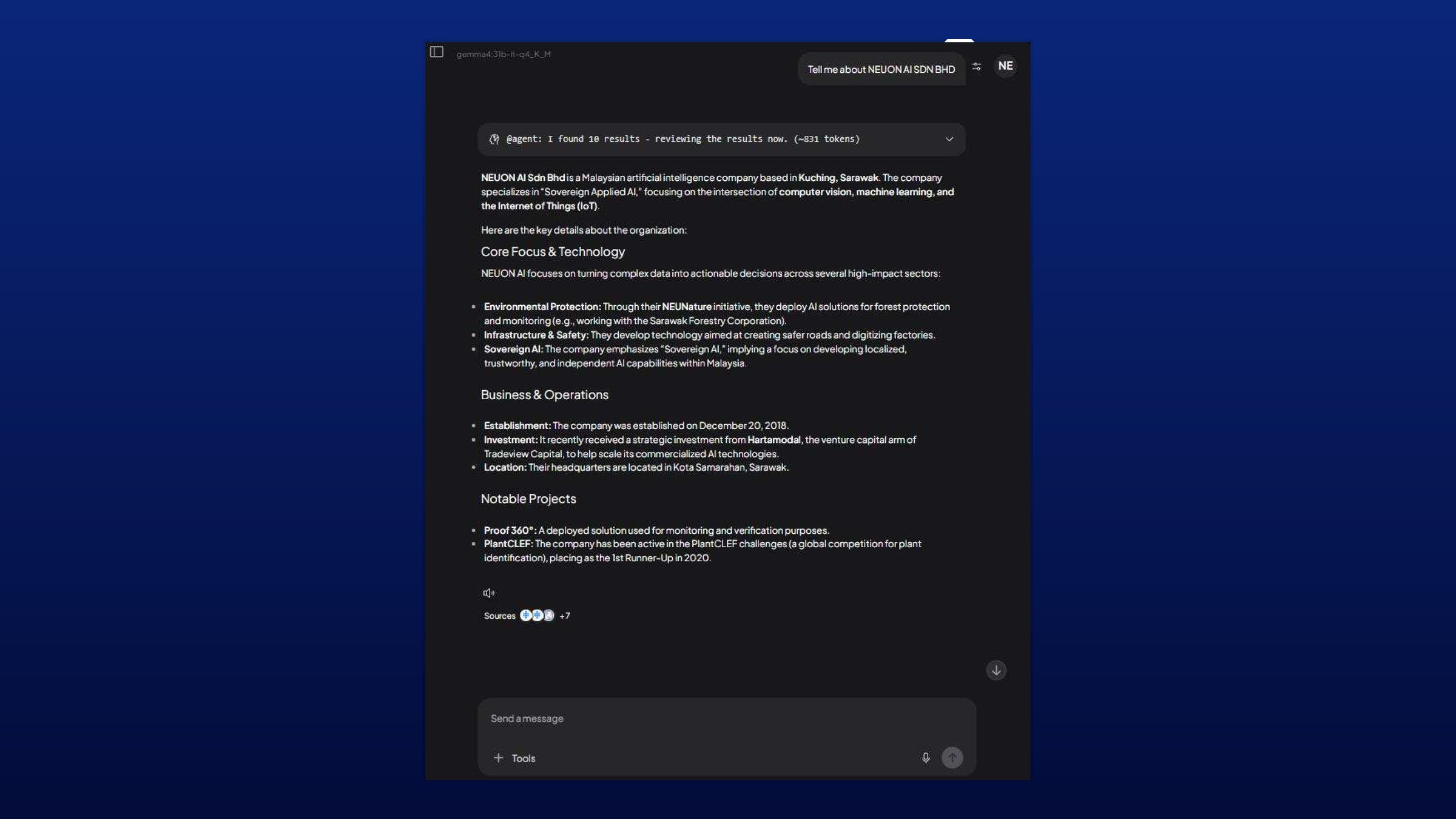
An open-weight model on your own hardware, reading your own records, printing its sources.
The institution's own documents → a local index → a small model on local hardware.→ An answer you can check
In words
The third picture is a chat window with one question in it — "Tell me about NEUON AI SDN BHD" — and the model's name in the top corner: gemma4:31b-it-q4_K_M. That string is most of the argument. It is an open-weight, instruction-tuned model quantised to four bits, which is what lets a model of that size run on hardware an organisation can own outright instead of renting by the token.
Above the answer the retrieval step reports itself — "I found 10 results · reviewing the results now (~831 tokens)" — and underneath it, the sources. The model is not being asked to remember anything. It is being asked to read what it was handed and say where each part of the answer came from. That is the difference between an answer and a guess, and it is the only version of this that survives being audited.
Nothing in that exchange leaves the building. No document is uploaded to anybody's API, no question is logged by a vendor, and the token count in the corner is a compute cost rather than an invoice. This picture is a demonstration of the arrangement, not a fact sheet about the company — for what NEUON AI does and where it is, the rest of this site is the authority.
- The answer is structured, not prose — core focus and technology, business and operations, notable projects — because that is what the question was worth and what the retrieved documents supported.
- Sources under every answer. An answer with no sources cannot be checked, and an answer that cannot be checked cannot be used for anything that matters.
- On this site it is already named Local EdgePack — the whole engine packaged to run inside an institution's own walls, sovereign by deployment rather than by policy.
Next
Bring your own documents.
The shortest way to know whether this works on your records is to run it on your records. Send a handful of the forms you actually receive — the messy ones, not the clean ones — and we will show you what comes out the other side.
- A sample. Twenty or thirty real documents of the kind you have most of.
- A field list. What you would want to be able to query, in your own words.
- A read-out. What was extracted, what was not, and what it would take to close the gap.